

Blog – What is lot and common property?
Hi everyone, it’s Allison Benson here from Thoughts from a Strata Lawyer.
And today I’m going to be starting to address Strata 101 or at least that’s what I call it.
So, the question today is, what is lot and what is common property?
Well, the definition of common property is that it’s residual.
Basically, whatever is not shown on your strata plan as a lot is common property and that’s what I mean by residual. The key thing is the definition of what is a “lot”? Now, that’s found in section 4 (note I said section 5 but I should have said section 4) of the Strata Schemes Management Act 2015. That definition picks up the definition from section 4 of the Strata Schemes Development Act 2015.
Please forgive me, I am going to read this because it is quite a quite a wordy definition. And the definition is”
“lot in relation to a strata scheme means one or more cubic spaces shown as a lot on their floor plan relating to the scheme, but does not include any common infrastructure unless the common infrastructure is described on the plan in the way prescribed by the regulations as part of the lot.”
Technical huh? Effectively, what it means is that you need to have a look at your strata plan, to see what has shown as your lot. Now, your strata plan will show you your lot’s floor plan.
You need to have regards to that floor plan in relation to the lot boundaries as well because you’ll see on your strata plan (and I’ll put some extracts down below some really good examples), you’ll see on your strata plan thick black lines, sometimes you’ll see some thin black lines. Sometimes you’ll see some thin dotted lines.
What are they all mean? Basically the thick black lines will be common property. It’s usually the common property will be the façade of the building. Sometimes there may be some more structural elements like it may be a wall or a door leading from the internal part of a lot to a balcony or to a courtyard or to a garage even.
You may also need to check on your strata plan to see if your lot has a garage on a different level or a storage facility on a different level, and it’s not unknown for lots to be across different levels.
- So check your strata plan. That is strata 101.
Pre-1 July 1974 Plans
See what has been shown on your strata plan as a lot. What you’ll see and in the extract below, I’ve deleted out the actual strata plan number, but you can see from the extract that it is a pre 1974 plan.
(Please forgive my dog bells. They’ve just decided to bark.)
It’s a pre-1974 plan. What that means is that you need to be particularly careful about any areas that lead from one part of the lot out to another part of the lot because they, even if they’ve got a vinculum, which is a backwards looking “S” (I’ll put the extract down below for you with that) but anything that’s linked with the vinculum, even if it’s got a thick black line, is likely to be lot property, depending upon the notations on your strata plan , and that’s because our pre-1974 plans had different rules that applied to plans that were registered after the 1 July 1974.
This is the prime exception to the rule that where there is a thick black line it means that structure is common property.
In all other schemes, the thick black line is common property unless there’s a notation on the strata plan. So, our more recent strata plans are very, very different to pre-1974 plans.
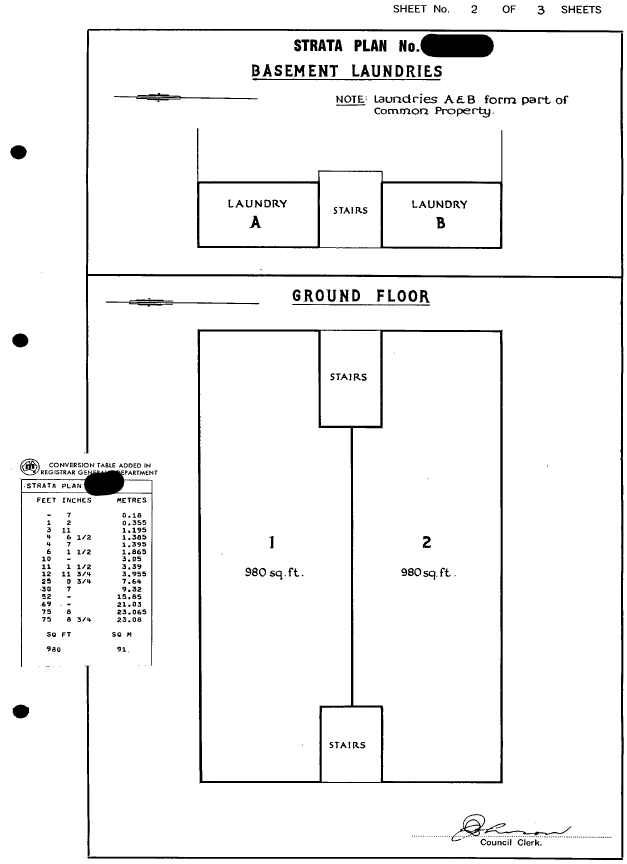
But have a look down below in the link and what I’ve put is an extract of the plan. Um and you’ll see that there is actually an area that’s marked laundry A and laundry B and there’s stairs. That’s just a little extract and you can see on the ground floor. They’re (the laundries) in the basement, I should say.
You can see on the ground floor that it looks like there’s lot 1 and lot 2 and some stairs . So where you see one or something that says “1” (sometimes it is “Pt” and then a number that just means part and lot). This is lot 1. (PT 1 would also mean lot 1).
You can see the floor area or the floor space area. In this case it’s an older plan so it’s in square foot, but you can see in the extract below our extract as well, that it’s been converted at some point in time to square metres for those of us that don’t do imperial measurements.
Again, anything that’s not numbered as a lot or mentioned as a lot in the notations is going to be common property.
You can see in this example, where it says that the basement laundries, laundry A and laundry B, there’s a little notation that says very, very clearly Laundries A and B form part of common property. Technically that’s not needed because there’s no lot number there, but it’s a really handy thing to see.
Modern Plans
In a more modern plan (again, I’ll put an extra down below for you), you can see there’s two lots and you can see that one lot has a very, very large courtyard (lot 1 shown as Pt 1) and you can see the thick black lines, and that’s the outline of the building , and then some structural elements of the building.
You can see a wall between the garage of lot 1 and the internal residence of lot 1. You can also see a thick black line in between the garage of lot 1, the internal residence of Lot 1, and what is denoted in the notes as “SR” or storage, so there’s obviously some structural elements in there.
The thin lines that thin dotted lines that you can see or they’re referring all there for the surveyor basically, their surveyor marks and they are taking measurements from the corners of the building.
But you can see the boundary of the lot very, very clearly thin black lines that’s where the boundary of the scheme (and the lot)is, but there’s no structures there or they may be fenced but there’s no building element as such so there’s no building on that line.
You can also see where the tiny part of lot 2 is, with some stairs and storage for lot 2 , and you can see that backwards “S,” which is a vinculum and that just joins the parts of lot 1 to each other.

So look at the strata plan. That’s the first tip.
2. Second tip, look at the by-laws.
Why? Because even if something is common property, the requirement for maintenance and repair, renewal and replacement, may actually be bound up in a common property rights by law, so always double check the by-laws.
Just because something is common property doesn’t mean that the owners corporation is always responsible for its repair and maintenance.
3. Look for special resolutions
Sometimes as well, you may need to dig a little bit deeper, there may have been a special resolution passed under section 108 of the Strata Schemes Management Act 2015 (or under its predecessor the 1996 Act section 65A) as a special resolution to alter the common property, or to add to the common property, so there may be a need in some cases need to check the meeting minutes as well, to figure out what is lot and what is common property.
4, Check the common property title for consolidations or subdivisions
Just to confuse things a little further, if you have had a strata plan of subdivision or consolidation, that will actually be registered on the common property certificate of title for the for the common property. So double check that (the common property title for registered dealings) and then you’ll have to download the plan and have a look as well.
Hopefully this has helped. It’s just a really quick guide to having a look and trying to ascertain what is and what is common property. It is harder than what it appears.
The strata plan is key to what is a lot. The definition of floor plan in the Act is key. Effectively, the skin of the walls, the skin of the paint of the walls, the upper surface of the floors, the undersurface of the ceiling, unless the strata plan notes otherwise , then check the by-laws, and if necessary, check the meeting minutes.
I hope that’s helped. As always, I really do encourage, particularly on this point because it is so key, that if you have any concerns, get advice because a lot of things ride on this point: maintenance costs, works, whether you’re allowed to do work if it’s a lot property or if it’s common property. Get the advice. It’s well worthwhile doing and then put it on the books and records.
Thanks for your time. Allison
 Thoughts from a strata lawyer ...
Hi Allison
Again, many thanks.
Good health
Barry Portus